Renegade Aesthetics

The aesthetic resistance to theory. Aesthetic indistinction. The aesthetic that theorizes itself. The sensitivities and perceptions that exceed theoretical vision. (Not) knowing it when you see it. Autonomy.
I-Love-Lucy-i-love-lucy-17796173-306-320
Does the new aesthetic turn adequately grapple with whether there can even be such a thing as aesthetic theory? InterCcECT is excited to host a reading group on Renegade Aesthetics led by special guest Benjamin Morgan. We’ll be tackling selections from very recent works by Steven Connor (“Doing Without Art”), Sianne Ngai (Our Aesthetic Categories), and Jacques Ranciere (Aisthesis). Contact us for PDFs.

Thanks to the generous partnership of The Scholl Center, we will meet Friday 9 August, 2pm, at The Newberry Library, room B92.

What are you theorizing? InterCcECT happily announces your events and eagerly receives your proposals. And don’t forget to connect with us on Facebook.

Leave a comment

Filed under Reading Groups

totality, represented: an InterCcECT reading group on Fredric Jameson

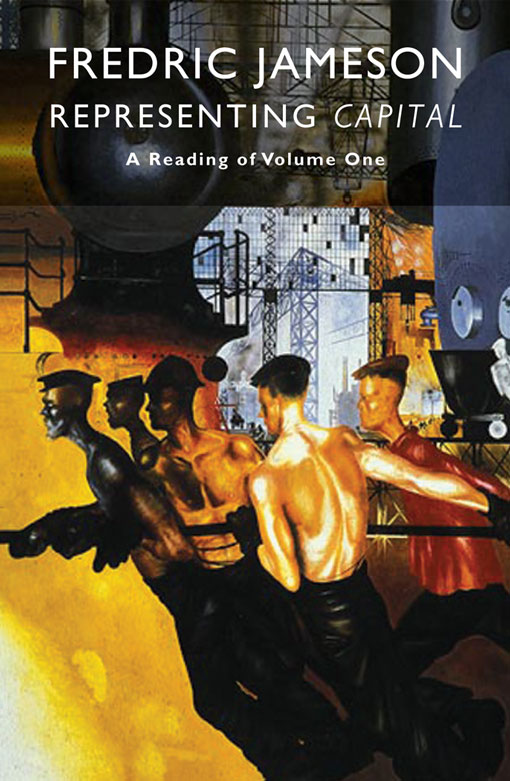
9781844674541-frontcoverJameson’s recent Representing Capital encounters Marx’s first volume through foregrounding the reading modes necessary to appreciate Marx’s writing modes, which are themselves not peripheral to the subject matter but essential.

Jameson writes “the central formal problem of Capital Volume I is the problem of representation: namely how to construct a totality out of individual elements, historical processes, and perspectives of all kinds; and indeed how to do justice to a totality which is not only non-empirical as a system of relationships, but which is also in full movement, in expansion, in a movement of totalization which is essential to its very existence and at the heart of its peculiar economic nature.”

Join InterCcECT for a reading of Jameson’s reading.
Friday, 28 June, 2pm
Bucktown / Wicker Park Public Library (Community Room, 2nd Floor).
1701 N Milwaukee, accessible via Blue Line Damen or Milwaukee, North, Damen, Western, and Armitage buses.

As always, to propose events write us us or connect on Facebook.

Leave a comment

Filed under Reading Groups

Psychoanalysis, Phenomenology, Paul: May’s finale; summer’s open vista


As semesters adjourn and quarters eye the end, InterCcECT invites you to propose summer projects. What are your summer reading goals? Writing goals? Want to convene a session or working group? We want you! Contact us us or connect on Facebook.

May is wrapping up with a theory bang around town; let some of these events this week from our calendar inspire your proposals to us!

17-19 May, Which Way Forward for Psychoanalysis?
19-21 May, Phenomenology Roundtable
20-21 May, Paul of Tarsus Working Group presents Aidan Tynan, “Belief in This World: Deleuze, Paul and the Apocalyptic Mood” and InterCcECTer Adam Kotsko, “What St. Paul and the Franciscans Can Tell Us About Neoliberalism: On Agamben’s The Highest Poverty”.

Leave a comment

Filed under Uncategorized

the void of / in Badiou’s Ontology: a talk by Tzuchien Tho

fWith the generous support of Gallery 400, InterCcECT is very pleased to present “Nothing Just Isn’t (what it used to be): The Void and Structure,” a talk by Tzuchien Tho, researcher at The Berlin-Brandenburgische Akademie der Wissenschaften and The Centre International d’Etude de la Philosophie Française Contemporaine. Join us Thursday 25 April at 4pm at Gallery 400!

abstract:
Alain Badiou inherited a series of concepts in the late 60’s that manifest a similar sort of argumentative strategy. From
Neo-Kantianism, French epistemologie, Hegelianism and structuralism, there were a number of different figures of the void, the nothing, indeed the “not”, all of which stood in as a reified repository for the undetermined and contingent (the virtual), the not-yet (the new in history), the horizon of determination and knowledge (regulative judgment). By looking at how Badiou refuted this construal of the problem of the void (the nothing and the like) in the late 60’s, I will demonstrate how these initial works led to his arguments concerning the void in the 1980’s provided a real alternative to those that he inherited. In turn, understanding Badiou’s rejection from this late 60’s context of treating the notion of the void sheds light on the meaning of his “mathematical ontology” through set theory and allows us to evaluate his larger philosophical project from a different historical vantage.

highlights from our calendar: — as always, Contact us to announce or propose events!
12-13 April, Norms of Freedom in Kant and Hegel
19-20 April, Death Penalties
20 April, Andrew Curran, Before Anthropology: Enlightenment Science and the Category of the Human
2 May, Jacques Derrida: Points of Departure

Leave a comment

Filed under Uncategorized

Cutrofello’s objective correlatives: of Hegel and Hamlet

InterCcECT is delighted to present a talk by Andrew Cutrofello, “Two Contemporary Hegelianisms,” Tuesday 19 March, 4pm, Newberry Library Room B82.
hamlet-6
Abstract:
Robert Brandom’s and Slavoj Žižek’s appropriations of Hegel seem radically different. Brandom’s Hegelianism takes the form of a semantic holism that is essentially normative and pragmatic. Žižek’s is a version of dialectical materialism that is avowedly perverse and revolutionary in intention. Curiously, however, there are significant parallels in the two philosophers’ conceptions of Hegelian spirit. These are evidenced in their respective readings of T.S. Eliot’s essay, “Tradition and the Individual Talent.” Nevertheless, Brandom’s and Žižek’s Hegels ultimately diverge with respect to the nature of reason and commitment. In my talk I will try to sketch these differences by bringing into play another of Eliot’s essays from The Sacred Wood, namely, “Hamlet and His Problems.” In this essay, Eliot develops his famous conception of the objective correlative, explaining why it goes missing in Shakespeare’s play. Brandom and Žižek, I suggest, have fundamentally different conceptions of Hegel’s “missing” objective correlative.

a few highlights from our calendar, which contains additional details:
8 March Issues in Phenomenology
13 March Gregory Flaxman “A More Radical Empiricism: The Philosophy of William (and Henry) James” at U of C
13 March Bill Martin, “Zen Maoism: An improbable Buddhist-Marxist synthesis”
15 March Paola Marrati on Deleuze

Leave a comment

Filed under Lectures

New Year, New InterCcECTions

networks
InterCcECT is pleased to commence the new year with a winter line-up bookended by two special events in contemporary philosophy:

24 January, 4pm: InterCcECT presents Andrew Benjamin, “Being-In-Relation,” Newberry Library, Room B82

19 March, 4pm: InterCcECT presents Andrew Cutrofello, “Two Contemporary Hegelianisms,” Newberry Library, Room B82

“Being-In-Relation: Philosophy’s Other Possibility,” Professor Benjamin’s latest project, revisits Descartes, Fichte, Kant, Hegel, and Heidegger in a radical attempt to think the priority of relationality to singularity. For the InterCcECT works-in-progress session, we will pre-circulate a draft of Chapter One, which establishes the parameters of the problem. Request the paper and join us!

In between, look out for our February event announcement, and check our calendar regularly for highlights from around town, like:

9 January, Wendy Brown, The Protoean Morphology of Homo Economicus
11 January, Graham Harman, A New Look at Identity and Sufficient Reason
17, 18, 25 January, Andrew Benjamin, The Fabric of Existence, Recovering Relationality, and more
31 January, Pierre Keller, Kant’s World Concept of Philosophy
13 February, Elizabeth Rottenberg, Freud’s Other Legacy

InterCcECT wants to hear your theory new year’s resolutions! Contact us to announce or propose events, and “like” us on Facebook for frequent links.

Leave a comment

Filed under Uncategorized

Red October


InterCcECT proudly presents Jodi Dean, “The Communist Horizon” Saturday 27 October, 4:30pm, generously hosted by Gallery 400. Based on her brand new book, the talk urges us to imagine new Octobers.

*theorizing October*

(highlights from our calendar, which contains additional details):

12 Oct Laurence Hemming, “Production: Formerly This Was Called God: Heidegger in dialogue with Marx”
13 Oct Frances Ferguson, “Economic and Sentimental Reasons”
15 Oct Anthony Paul Smith, “Liberating Lived Experience: François Laruelle and the Work of NonPhilosophy”
16 Oct Michael Hardt, “The Right to the Common”
16 Oct Ramin Takloo-Bighash, “History, Theory, and Practice of Prime Numbers”
17 Oct Adam Kotsko, “Agamben on Liturgy and Politics”
17-19 Oct UIC French, “Inequality and Exclusion:The Theory and Practice of Human Rights”
18 Oct Achille Mbembe, “Notes on Fetishism and Animism”
26-28 Oct DePaul Philosophy, “Hegel and Capitalism”
29 Oct Danielle Bergeron, “Psychosis As It Is Lived”

InterCcECT encompasses you! Contact us to propose or announce your October aspirations and “like” us on Facebook for frequent links.

Leave a comment

Filed under Lectures

the fantasy of democracy, the desire of communism

InterCcECT is delighted to announce a lecture by Jodi Dean, “The Communist Horizon,” Saturday 27 October, 4:30pm, presented at Gallery 400 with their generous support. Based on her book forthcoming in late October, the talk proposes new ideals for communism today.


In preparation, InterCcECT will host a reading group on excerpts from Dean’s recent book Democracy and Other Neoliberal Fantasies, along with selections from the comrade anthology The Idea of Communism. Join us Thursday 4 October at The Newberry Library, room B82, 3pm. PDFs available upon request .

*this week in theory*
(highlights from our calendar, which contains additional details):

5 September Graeber’s Debt (History of Capitalism reading group)
5 September Kant’s Critique of Pure Reason (German Philosophy reading group)
6 September Leibniz’s Exoteric Philosophy (Lecture by John Whipple)
7 September “Kristeva’s Severed Heads: Sadomasochism and Sublimation” (Lecture by Kelly Oliver)

What’s on your docket? As always, Write us to propose or announce events, and “like” us on Facebook for frequent links.

Leave a comment

Filed under Lectures, Reading Groups

Lukacs, Lacan, and the waning of summer

InterCcECT reminds you to attend our upcoming sessions on Lukacs and Lacan:

Monday 13 August, refine your sense of realism in the 19th, 20th, and 21st centuries by discussing “Realism in the Balance” and “Reportage or Portrayal” with special guest Annie McClanahan of UW Milwaukee’s Center for 21st Century Studies. 4pm, InterCcECT Salon in Bucktown; email us for PDFs and details.

Thursday 16 August, refine your sense of reality by discussing Seminar 3: The Psychoses, chapters 9 &10, 5pm at the Salon.

Close thy summer, open thy Kant: Critique of Pure Reason reading group begins Wednesday 29 August, 6pm, Bourgeois Pig cafe.

Also note: David Graeber’s Debt reading group, Wednesday 5 September, 1:30pm, UIC University Hall 1050.

Got good reads on your summer bucket list? We always welcome event proposals.

Leave a comment

Filed under Reading Groups

realism in these times

What are the formal constructions of realism in art and literature? What, if anything, distinguishes the realism of nineteenth-century capitalism from the realism of twenty-first-century capitalism? What binds Breaking Bad to Balzac? InterCcECT, with special guest Annie McClanahan, turns to Georg Lukacs for renewed debate on realism in these times. Read “Realism in the Balance” and “Reportage or Portrayal” and join us Monday 13 August, 4pm, at the InterCcECT salon in Bucktown; contact us for details and PDFs.

Our continuing conversation on the realism-complex of psychosis convenes Thursday 2 August, 3pm for Lacan’s Seminar 3, Chapters 7-8.

We highly recommend the History of Capitalism Reading Group’s next session, Wednesday 1 August, 1pm, on Arrighi’s The Long Twentieth Century. Check our calendar for details on these and other events.

Have a summer reading bucket list? A fall mini-seminar wish list? InterCcECT welcomes your announcements and initiatives.

Leave a comment

Filed under Reading Groups