speculation upon speculation

What does the financial crisis of 2007-2008 and our ongoing catastrophe have to do with the recent surge of scholarly interest in speculative philosophy?  How do proliferating materialisms engage with, or symptomatize, toxic collateralized debt obligations?  What is the shared terrain of speculative action, and where does political action intervene to remake that terrain?

empoweretihad
InterCcECT is pleased to welcome Josh Robinson (Cardiff University) for a special works-in-progress session on Speculative Capital, Thursday 6 October.  Join us at 4pm at the UIC Institute for the Humanities, 701 S Morgan St (Blue Line: UIC/Halsted).  Pre-circulated paper available by request to interccect at gmail.

Josh will also be at the Poetry&Poetics workshop at UofC on Monday 10 October.

Also on our fall calendar:

Arendt’s The Promise of Politics, 3 October

Jodi Dean at UIC, 20 October

Etienne Balibar and Veronica Gago at 3CT, 28 October

Debt Dialogues at Northwestern

Aaron Schuster at InterCcECT, 28 November (ditto)

Knox Peden at UIC, 2 December (ditto)


Leave a comment

Filed under Miniseminars

Anxiety, the seminar, Depression, the album

ingrid-bergman-02InterCcECT allays summer angst with a special session on Jaques Lacan’s recently translated Seminar X: Anxiety, led by Professor Chris Breu.  We’ll focus on the first section (chapters 1-6); readings available by request to interccect at gmail.  Join us Thursday, 11 August, 5pm, at Volumes Bookcafe (back room),  1414 N Milwaukee Ave (Blue Line: Damen).

3 Comments

Filed under Miniseminars, Reading Groups

Why Psychoanalysis?

When both scientism and the so-called “post-critical” movement are ascendent, what can possibly be the purchase of psychoanalysis?  Unknown Alenka Zupancic is going to tell us!  Join us Tuesday 14 June for a reading group on her very short book “Why Psychoanalysis: Three Interventions.”  We’ll meet in the garden at Handlebar at the luxuriantly summery hour of 3pm.  Drop a note to interccect at gmail for the readings.

Leave a comment

Filed under Reading Groups

Symptom, Scale, World: 3 sessions on theory and criticism

InterCcECT compatriot`V21 Collective is hosting a series of reading groups this summer on debates in literary theory and criticism, including psychoanalysis and postcritique, world-systems theory and world literature, and distant reading. 54fe70c5e58ece05b40000ea_learning-hub-heatherwick-studio_666_06_learning_hub_detail_of_lift_lobby_and_bridge_connections_credit_hufton_and_crow  Check out the syllabus below and see v21collective.org for more details; the first session is June 21.

SYMPTOM
Sigmund Freud, An Analysis of a Case of Hysteria
Fredric Jameson, The Political Unconscious (excerpt)
Eve Sedgwick, “Paranoid Reading and Reparative Reading”

WORLD
H.G. Wells, The Time Machine
Immanuel Wallerstein, World Systems Analysis: An Introduction (excerpt)
Jason Moore, Capitalism and the Web of Life (excerpt)

SCALE
Immanuel Kant, “On the Mathematical Sublime”
Franco Moretti, “Graphs, Maps, Trees”
Mark McGurl, “The Posthuman Comedy”
Julie Orlemanski, “Scales of Reading”

Leave a comment

Filed under Reading Groups

Encyclicals: Hegel continues

neues-bild2Join us for another session on Hegel’s Encyclopedia Logic, this Friday, 13 May, 3pm at The Bourgeois Pig (Red Line: Fullerton).  We’ll continue with Sections 19-36  –  let us know if you need the readings.  And contact us to propose additional summer events!

Leave a comment

Filed under Reading Groups

Encyclopedia Brown: a summer of Hegel kicks off 6 May

Encyclopedia-1InterCcECT will host a series of reading groups this summer, and the first focuses on the beginning of Hegel’s Encyclopedia Logic (Prefaces and Sections 1-18). Join us Friday, 6 May, 2:30pm at the south loop’s Little Branch Cafe, 1251 S Prairie Ave (Roosevelt “L”). Drop a note to interccect at gmail if you need the readings (we are using the Hackett Classics Edition/ Translation). As always, contact us to propose events, and follow us on Facebook for frequent links.

also on our books:
4 May, Fred Moten

11-13 May, Modernities: Old Problems, New Approaches

23 May What is Critical Theory?

Leave a comment

Filed under Uncategorized

Hegel’s Kilogram

What maps can relay the convergences and divergences, the topoi and the antagonisms, of philosophy and science?  How might the very terrain of modernity take different shape if these maps were recast?

InterCcECT is delighted to present “Hegel’s Kilogram,” a lecture by Nathan Brown, Director of the Centre for Expanded Poetics at Concordia University.   Join us Thursday 14 April, 4:30pm, at the gallery of our generous partners Sector 2337, 2337 N Milwaukee Ave (Blue Line: California).
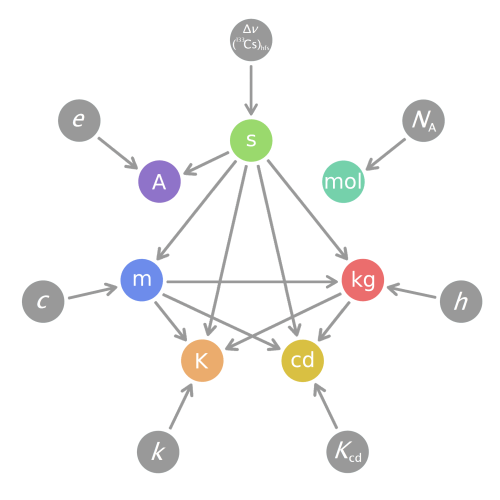
System of Units

 
Abstract:
Hegel’s Kilogram: On the Measure of Metrical Units
Hegel’s theory of measure, articulated in the Science of Logic, was developed shortly after the foundation of the metric system in the late 18th century. The establishment of physical standards for the meter and the kilogram, fabricated and archived at the International Bureau of Weights and Measures in Sèvres in 1799, illustrates Hegel’s understanding of measure as “the concrete truth of being” in a curiously salient way, demanding consideration of the relation between scientific accuracy, metaphysical speculation, and material particularity. The metric system instantiated universal standards of measure in singular physical objects, themselves created through meticulous measurement practices, thus dramatizing the problem of grounding in relation to both particular metrical units and the practice of science in general.
What is at stake, conceptually and empirically, when these inaugural units are themselves redefined? Since the 1960s, key standards of the International System of Units (SI) have been redefined on the basis of numerical constants, such as the speed of light (c) and the elementary charge (e), rather than physical objects. This paper considers ongoing efforts to redefine the kilogram unit on the basis of the Planck constant, focusing in particular on Watt Balance experiments carried out at the National Institute of Standards and Technology. These experiments offer a fascinating contemporary case study of the problem of measure. Considering both their empirical operations and their conceptual implications, I argue that the redefinition of metrical units is a key site for thinking not only the imbrication of epistemology and ontology, but also for understanding the history of modernity at the crux of science and philosophy.


Before and After, mark your calendars:

April 1 GENERAL STRIKE

April 4  Henry James, Media Archaeologist

April 15 German Philosophical Aesthetics

April 18 Lyotard, The Postmodern Condition

Leave a comment

Filed under Lectures

peoples and parties: the state of anti-statism

What formations of the people would amount to collective sovereignty, rather than the mere management of populations?  How can the party or the state be rethought in our era of obscene electoral politics and pervasive state violence?  What distinguishes academic anti-statism from market-fundamentalist disintegration of the state?

tumblr_o27lljUUvy1riaiodo8_1280

InterCcECT hosts a special reading group session featuring selections from Jodi Dean’s Crowds & Party and Michel Foucault’s The Birth of Biopolitics, facilitated by Daniel Zamora (of Foucault & Neoliberalism notoriety).

Join us Tuesday 29 March, 4pm, UIC Institute for the Humanities (Stevenson Hall basement, 701 S Morgan St, Blue Line: UIC Halsted).

Materials available by request: interccect at gmail.

Leave a comment

Filed under Reading Groups

like the weather: an Eve Sedgwick mini-seminar

Eve Sedgwick’s profoundly supple thought surprisingly instigates both queer theory as we know it and that riposte to queer reading now called “post-critique.”  Her arc was dynamic, capacious, unpredictable, and we have only barely begun trace it.

IMG_5290InterCcECT is delighted to host a mini-seminar on Sedgwick’s work, led by Professor Zach Samalin.  Readings span the poles of her career and include “Epistemology of the Closet: Axiomatic”; “The Weather in Proust”; and “Melanie Klein and the Difference Affect Makes.”  Materials available by request: interccect at gmail.

Join us Wednesday, 27 January, 5pm, at the Newberry Library (basement seminar room).  Red Line: Chicago.

*

Check back soon for the announcement of our February session with Daniel Zamora.

Also on our calendar:

12 Jan Jason Moore, Capitalism in the Web of Life

22 Jan Pete Coviello, The Wild Not Less Than the Good: Thoreau, Sex, Biopower

25 Jan Adam Kotsko @ UIC School of Architecture

28-29 Jan Beauty & Form

Leave a comment

Filed under Miniseminars

decolonizing images

Through what processes of mediation, under what circumstances, down which paths of struggle, can colonialist iconography be appropriated for anti-colonial nationalism? What are the wages of the image for the work of sovereignty? Is photography trans-contextual?Flandrin image

 
InterCcECT is delighted to present Casablanca Retro: Colonial Photography, History and Memory in Postcolonial Morocco, a talk by Patricia Goldsworthy Bishop. Join us Thursday, 5 November, 7pm, at the arts & events space of our partners Sector 2237,2337 N Milwaukee Ave (Blue Line: California).

Talk Abstract:

Throughout the colonial era photographers such as Marcelin Flandrin, an Algerian pied-noir who settled in Morocco at the establishment of the protectorate, collaborated with the government and tourism boards to construct a European vision of North African society and history. Known as the photographer of Casablanca because of his heavy involvement with the Protectorate government, after independence Flandrin’s work was criticized for reproducing Orientalist stereotypes and supporting the colonizing mission. Since the 1980s, however, Moroccan cultural, educational, and financial institutions have reinterpreted Flandrin’s images in order to resituate the protectorate as a part of Moroccan, rather than French, history. This talk traces Flandrin’s transformation from an archetypal French colonial photographer to a part of Moroccan heritage through an analysis of Flandrin’s 1928 and 1956 publications on photographs of the city of Casablanca (Casablanca from 1889 to the Present) and their subsequent reprinting by Moroccan scholars in 1988 (Casablanca Retro). Through the reinterpretation of these images and the appropriation of Flandrin by Moroccans, we can see the process of writing, resisting, and revising history and the instrumental role played by imagery in this process in colonial and post-colonial Morocco.


Our theory itinerary for the coming weeks:

20 Oct, Liquidity/Value: Reconceiving Marx for an Era of Financialization
22 Oct, The Sovereign’s Personal Element
23-24 Oct, Thinking Universalities
29 Oct, Experts and their Images
29-31 Oct, Revolutions in the Concept of Form
18 Nov, Civil War and Imperialism: Unimagining Community in the British Empire

To propose or announce events, contact us at intercecct @ gmail, or find us on Facebook.

Leave a comment

Filed under Lectures