
How is it possible to think a world without the givenness of the world, to think the thing-in-itself after Kant?
InterCcECT will open the new year with this possible new thinking: the speculative materialism of Quentin Meillassoux. Our discussion will focus on Meillassoux’s “Divine Inexistence,” the Appendix to Graham Harman’s recent book Quentin Meillassoux: Philosophy in the Making. (PDF file available upon request.) Meillassoux’s lucid and brief (albeit intricate) book After Finitude is recommended background reading.

Join us Tuesday 24 January at 4pm. Contact us for the address; and, as always, be sure to write to us with any events you’d like to propose or announce, especially texts you’d like to read or works in progress you’d like to share.
Category Archives: Uncategorized
necessary contingency, divine inexistence, and other (de)feats of finitude
Filed under Uncategorized
this week in theory: Mbembe and Hägglund
InterCcECT’s ongoing readings on sovereignty merge with a companion working group this week for a discussion of Achille Mbembe’s On The Postcolony, at the UIC Institute for the Humanities (701 S Morgan Street 60607), Thursday 17 November, 3-5pm.
Friday 18 November at 1:30pm, Martin Hägglund talks about his forthcoming book Dying For Time From Socrates to Lacan and beyond. Response by Peter Fenves. Northwestern University’s Kresge Hall 2-360, (1800 Campus Drive 60208).
What’s next week? Send us any events you’d like to announce or propose.
Filed under Uncategorized
The Royal Remains

In The Royal Remains: The People’s Two Bodies and the Endgames of Sovereignty, Eric Santner anatomizes the fleshly remainders that incorporate the seemingly disjointed regimes of royal and popular sovereignty. Focusing on what Foucault calls the “strange material and physical presence of the King” as it uncannily animates the body politic, Santner’s analysis offers a bold new account of biopolitics, a strategic plea for psychoanalysis, and riveting readings of modern aesthetics.
InterCcECT is thrilled to host a very special session with Professor Santner discussing his work. Join our continuing conversation on sovereignty, Monday 24 October at 6pm. Contact us for directions.
Filed under Uncategorized
murals of power, walls of weakness
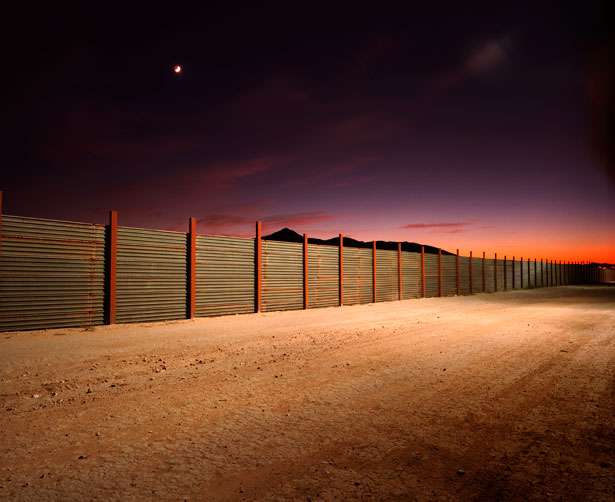
U.S. Mexico Wall (National Geographic)
In Walled States, Waning Sovereignty, Wendy Brown considers walling movements as iconographic of sovereign predicaments in the post-Westphalian age. “If walls do not actually accomplish the interdiction fueling and legitimating them,” she writes, “if they perversely institutionalize the contested and degraded status of the boundaries they limn, they nevertheless stage both sovereign jurisdiction and an aura of sovereign power and awe. Walls thus bear the irony of being mute, material and prosaic, yet potentially generative of theological awe largely unrelated to their quotidian functions or failures.”
Join InterCcECT for a discussion of these ironies next week. Tuesday 23 August, 4pm. Contact us for directions.
Filed under Uncategorized
 InterCcECT